
The Howe Truss: How a Few Iron Rods Changed the Covered Bridge
The Howe Truss: How a Few Iron Rods Changed the Covered Bridge
Stand inside a Burr arch bridge and everything you see is wood. Pegs, chords, braces, the big laminated arch sweeping overhead. Stand inside a Howe truss bridge and you'll spot something different: vertical iron rods, threaded at the ends, running from the top chord to the bottom one, with a nut and a cast-iron shoe at each end. That small change, made by a Massachusetts millwright in 1840, is arguably the moment the wooden bridge started turning into the steel one.
A sawmill kid from Spencer
William Howe was born in Spencer, Massachusetts, in May 1803. His father ran a sawmill, which is about the best possible upbringing for someone who would spend his life thinking about how timber carries load. He apprenticed as a carpenter, finished at Leicester Academy, and built a decent regional reputation putting up houses and churches. The churches were what people knew him for at first.
Inventing seems to have run in the family. His older brother Tyler came up with the box spring bed. His nephew Elias Howe patented the first practical sewing machine. William's contribution was less domestic but a good deal larger.
In 1840 the Western Railroad needed to cross the Connecticut River at Springfield, and Howe got the job. Railroads were the problem that wooden bridges of the day couldn't quite solve. A locomotive and a string of loaded cars weighed far more than any ox team, and the load moved, which meant the diagonal braces in a wooden truss were constantly being loaded and unloaded as the train rolled across. Joints worked loose. Bridges sagged. Howe's answer was to stop asking wood to do the one thing it does badly.
What the iron rods actually do
A truss carries load by splitting it between members in compression (being squeezed) and members in tension (being pulled). Timber is excellent in compression. It's mediocre in tension, not because the wood itself is weak but because the joints are: you can only cut so much of a notch or drive so many pegs before the connection fails before the beam does.
Howe's patent, granted in 1840, kept the wooden diagonals, which are in compression, and replaced the wooden verticals with wrought-iron rods, which are in tension. Iron is superb in tension and, crucially, a threaded rod with a nut on the end is adjustable. If the bridge began to sag after a few seasons, a crew could walk in with a wrench and take up the slack. During construction, tightening the rods pre-loaded the whole truss so it was rigid before the first wagon crossed.

Photo by Tony Fischer Photography (CC BY 2.0, via Openverse)
The other advantage was that it was the first American truss designed with real stress analysis rather than rule of thumb. Ithiel Town's lattice worked because it had so many members that something always held; Theodore Burr's arch worked because the arch quietly did most of the lifting. Howe's truss worked because someone had actually done the arithmetic on each rod and brace. Railroads, which were run by engineers rather than county commissioners, noticed.
Selling the patent
Howe didn't get rich the slow way. One of his workmen, Amasa Stone, who happened to be his brother-in-law, bought the New England rights to the patent in 1842 for $40,000 (well over a million in today's money), with backing from a Springfield businessman named Azariah Boody. Boody, Stone & Co. then built Howe truss bridges across New England for years. Stone went on to become a railroad magnate in Ohio; Howe went on to refine the design and patent an improved version in 1846.
He didn't get to enjoy it for long. A carriage accident killed him in September 1852, at 49, and he was buried in Springfield. The truss outlived him by a considerable margin. When wrought iron got cheap enough to build entire bridges from it, engineers kept the Howe layout and swapped the timber for metal. Later, they flipped the diagonals to make the Pratt truss, which is the one you see on most surviving 19th-century iron bridges. So the geometry of a modern steel truss bridge is, in a fairly direct sense, a descendant of a wooden bridge in Springfield.
Where to see one
Among covered bridges that are still standing, the Howe truss is the second most common type after the Burr arch, at roughly 140 bridges. They aren't hard to find, but a few are worth a detour.
Photo by Onasill ~ Bill Badzo (CC BY-NC-SA 2.0, via Openverse)
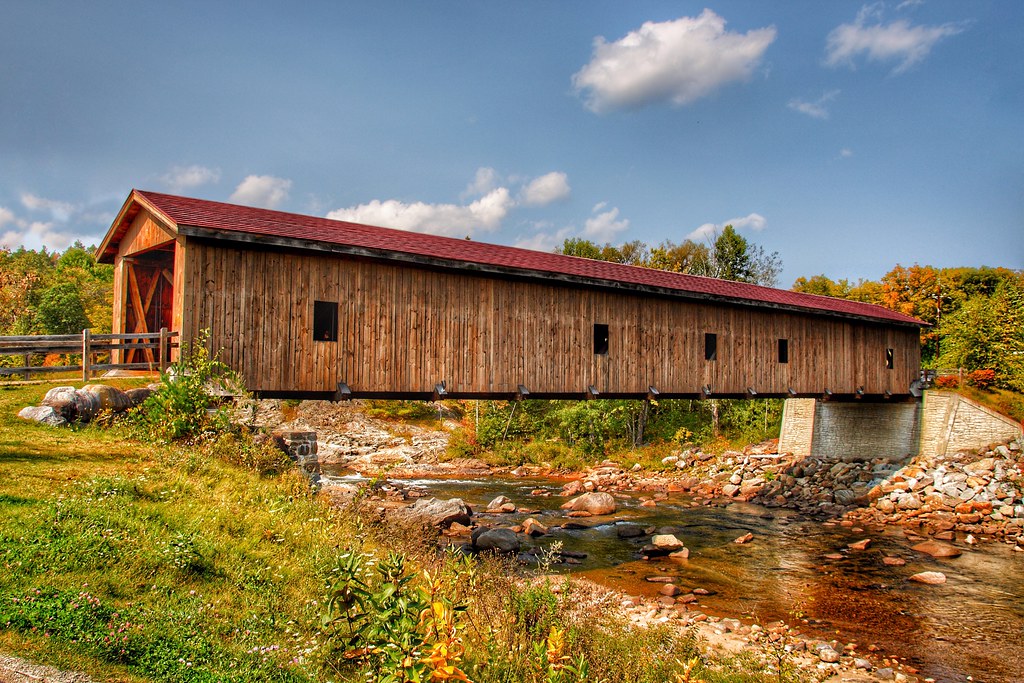
The Jay Bridge in Essex County, New York, crosses the east branch of the Ausable River in the Adirondacks. The first bridge on the site washed out in 1856 and the town rebuilt it the next year as a Howe truss. In 1953 a heavy truck went through the deck and 80 feet of one end had to be replaced. Traffic moved to a steel bridge downstream in 1997, and the original was restored for foot and bike traffic. It's one of only two covered bridges in the entire Adirondack Park, and the framing is big enough that you can read the whole system standing at one portal.
The Comstock Bridge in East Hampton, Connecticut, built in 1873 across the Salmon River, is smaller, with an 80-foot Howe main span and a 12-foot roadway. It's pedestrian only, which makes it the better bridge for actually studying the rods and shoes up close without a pickup coming at you. Connecticut has just three historic covered bridges left, and this is the one nobody argues about.
And if you want Howe trusses in bulk, go to Oregon. The state highway department standardized on the design in the early 20th century, so nearly every one of Oregon's fifty-odd covered bridges, from the red Shimanek Bridge in Linn County to the Chambers railroad bridge in Cottage Grove, is a Howe. They were building new ones into the 1960s, well after everyone east of the Rockies had given up on timber.
Which is a fair epitaph for Howe's idea. Most covered bridge trusses were superseded. His was absorbed.
Image credits: Thumbnail and Jay Bridge photo by Onasill ~ Bill Badzo, CC BY-NC-SA 2.0, via Openverse. Comstock Bridge interior by Tony Fischer Photography, CC BY 2.0, via Openverse.